
I Am Legend
Overview
Richard Matheson’s I Am Legend is a post-apocalyptic horror novel first published in the United States on August 7, 1954, by Gold Medal Books. Written in English and originally issued as a 160-page paperback, it combines vampire fiction, science fiction, and the emerging language of global disaster. The book is often credited with helping reshape modern vampire and zombie literature: instead of treating the vampire as a remote Gothic aristocrat or purely supernatural demon, Matheson places the figure in a recognizable modern city and offers a possible medical explanation for the catastrophe.
Plot and structure
The novel takes place after a devastating war and a plague that has killed almost everyone. The dead and infected return as vampire-like beings who fear sunlight, garlic, and mirrors, remain inactive during the day, and come out at night. Robert Neville, apparently the last uninfected human being, has converted his house into a fortress. He spends his daylight hours driving through the ruined Los Angeles area, finding sleeping vampires and killing them with wooden stakes. After sunset he retreats behind barricades while the creatures gather outside and call to him. Among the voices is that of Ben Cortman, a former neighbor and friend whose repeated summons turns Neville’s old community into an instrument of psychological torture.
Neville’s survival is both practical and emotional. His wife, Virginia, died during the plague and later returned as one of the infected, leaving him caught between grief, memory, and the necessity of self-defense. He drinks, repairs the house, searches for supplies, and endures the monotonous rituals required to remain alive. At the same time, he begins investigating the disease. By reading and experimenting, he tries to understand why the creatures react to sunlight, blood, garlic, and other traditional vampire symbols. His conclusions link apparent supernatural phenomena to bacteria, infection, and bodily vulnerability, giving the novel the investigative drive of science fiction.
A meeting with Ruth, a seemingly healthy woman, forces Neville to reconsider the meaning of survival. Her identity and loyalties reveal that the infected are not merely a mindless mob. They are developing a new social order, adapting to the changed world, and interpreting Neville’s daytime activities as murderous attacks. When this new society finally captures him, the familiar human viewpoint collapses. To its members, Neville is the abnormal and frightening remnant of an earlier age. The title’s meaning is therefore reversed: he is a legend not simply because he may be the last normal man, but because the new civilization will remember him as a terrifying figure from the past.
Themes and method
Loneliness is the novel’s central emotional condition. Neville is not isolated in an empty wilderness; he is surrounded by houses, possessions, memories, and voices that once belonged to ordinary social life. The house becomes both shelter and prison, while the repeated division between day and night turns time itself into a survival mechanism. Matheson’s attention to cooking, drinking, repairing, researching, and preparing defenses makes the apocalypse intimate rather than spectacular. The horror arises from repetitive labor, unresolved mourning, sexual frustration, and the gradual erosion of hope as much as from physical attack.
The novel also questions the authority of the word “normal.” Neville uses scientific reasoning to challenge supernatural explanations, yet he remains unable to imagine the infected as a society with its own perspective. His enemies likewise define him through their fears and inherited stories. Matheson thus turns the vampire tale into a study of majority power, cultural change, and moral relativity. What looks like a final stand for humanity from one angle can look like persecution from another.
Background and legacy
Written in the postwar period, I Am Legend reflects anxieties about mass destruction, epidemic disease, social collapse, and the fragility of modern civilization. Its innovation lies in bringing those anxieties into an ordinary domestic setting and presenting legendary monsters as the possible result of a contagious biological process. The novel inspired later vampire and zombie fiction, influenced filmmakers including George A. Romero, and helped popularize disease-driven worldwide apocalypse as a fictional model. It was adapted as The Last Man on Earth in 1964, The Omega Man in 1971, and I Am Legend in 2007. Each film reworks the story substantially, but the novel’s moral reversal remains its defining achievement. It endures as a landmark of modern horror and as a bridge between science fiction, epidemic fiction, and post-apocalyptic literature.
About the Author
Early life and education
Richard Burton Matheson was born on February 20, 1926, in Allendale, New Jersey, to parents of Norwegian immigrant heritage. He grew up in Brooklyn, New York. Matheson began writing at an early age, and stories and poems were published while he was still young. This early connection with ordinary domestic and urban life became central to his later fiction. Rather than placing terror only in distant castles or imaginary kingdoms, he regularly introduced the extraordinary into houses, streets, families, and recognizable routines.
During the Second World War, Matheson served in an infantry unit. The experience exposed him to death, fear, and the vulnerability of an individual within a large-scale catastrophe. After the war he attended the University of Missouri, where he earned a degree in journalism. His journalistic education contributed to the direct, economical, and concrete style that became one of his strengths. Even when he wrote about supernatural events, his settings and details often feel observed rather than invented, allowing impossible situations to acquire the pressure of everyday reality.
Writing career
Matheson’s professional career extended from approximately 1950 until 2013 and included novels, short stories, screenplays, and television writing. His 1954 novel I Am Legend became his best-known work. It transformed the vampire story into a modern epidemic narrative, following Robert Neville, an apparently uninfected survivor who lives alone among infected, vampire-like beings. The novel’s scientific explanation of traditional vampire characteristics and its final reversal of the word “normal” helped influence later vampire, zombie, and post-apocalyptic fiction.
His 1956 novel The Shrinking Man is another major work. It follows a man whose body gradually becomes smaller and uses physical transformation to examine identity, fear, and the individual’s changing relationship with the world. Matheson also wrote across a wide range of genres, including science fiction, horror, fantasy, suspense, paranormal fiction, and the western. His work frequently centers on ordinary people confronting extraordinary forces, while resisting a simple division between realistic and fantastic storytelling.
Matheson was also a prolific screenwriter. He contributed to television programs including The Twilight Zone, Night Gallery, and Star Trek, and wrote for feature films. Several of his novels and stories reached the screen, including I Am Legend, Somewhere in Time, and The Shrinking Man. His television and film work extended his influence beyond book readers and helped establish forms of speculative storytelling in which psychological unease and social reality are as important as spectacle.
Reputation and death
Matheson received major recognition for both literary and screenwriting achievements, including the Hugo Award, the Edgar Award, the Spur Award, and Writers Guild awards. He later received lifetime-achievement honors from the World Fantasy Awards and the Bram Stoker Awards, and he was inducted into the Science Fiction Hall of Fame in 2010. These honors reflect a career that crossed genre boundaries and media forms.
Matheson died on June 23, 2013, in Calabasas, California, at the age of eighty-seven. His lasting reputation rests on his ability to make fantastic premises emotionally credible. He showed how horror could examine grief, isolation, scientific uncertainty, social prejudice, and the unstable boundary between human and monster. I Am Legend remains the clearest expression of that achievement and a major landmark in modern speculative fiction.
StoryFlow

Neville’s Survival Regimen
This flow traces Robert Neville’s transformation from a desperate survivor into a disciplined investigator who sustains himself through routine.
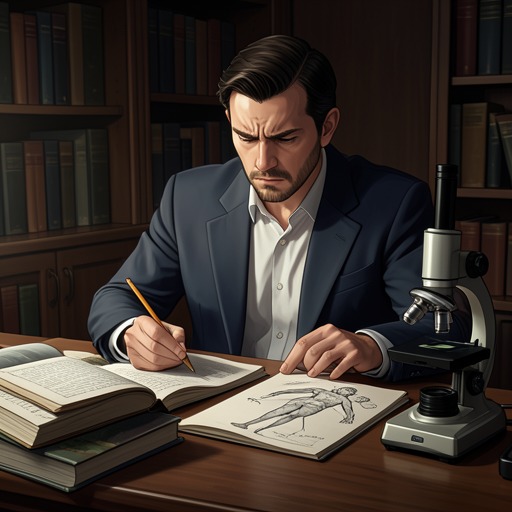
Investigation of Vampirism
This flow follows Robert Neville’s movement from inherited vampire lore toward an evidence-based account of vampirism.
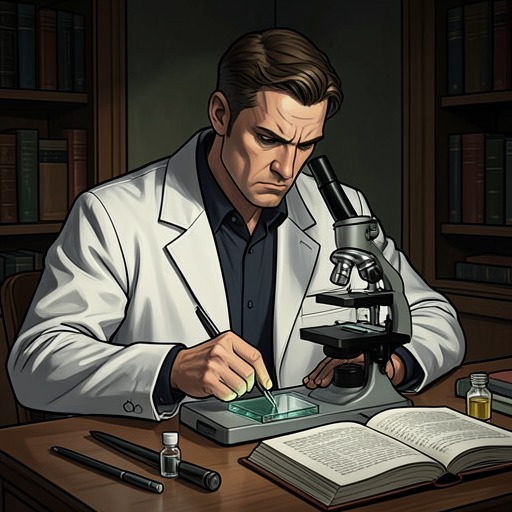
Discovery of the Vampiris Bacillus
This flow traces the decisive discovery that turns vampirism from legend into an identifiable biological infection.
